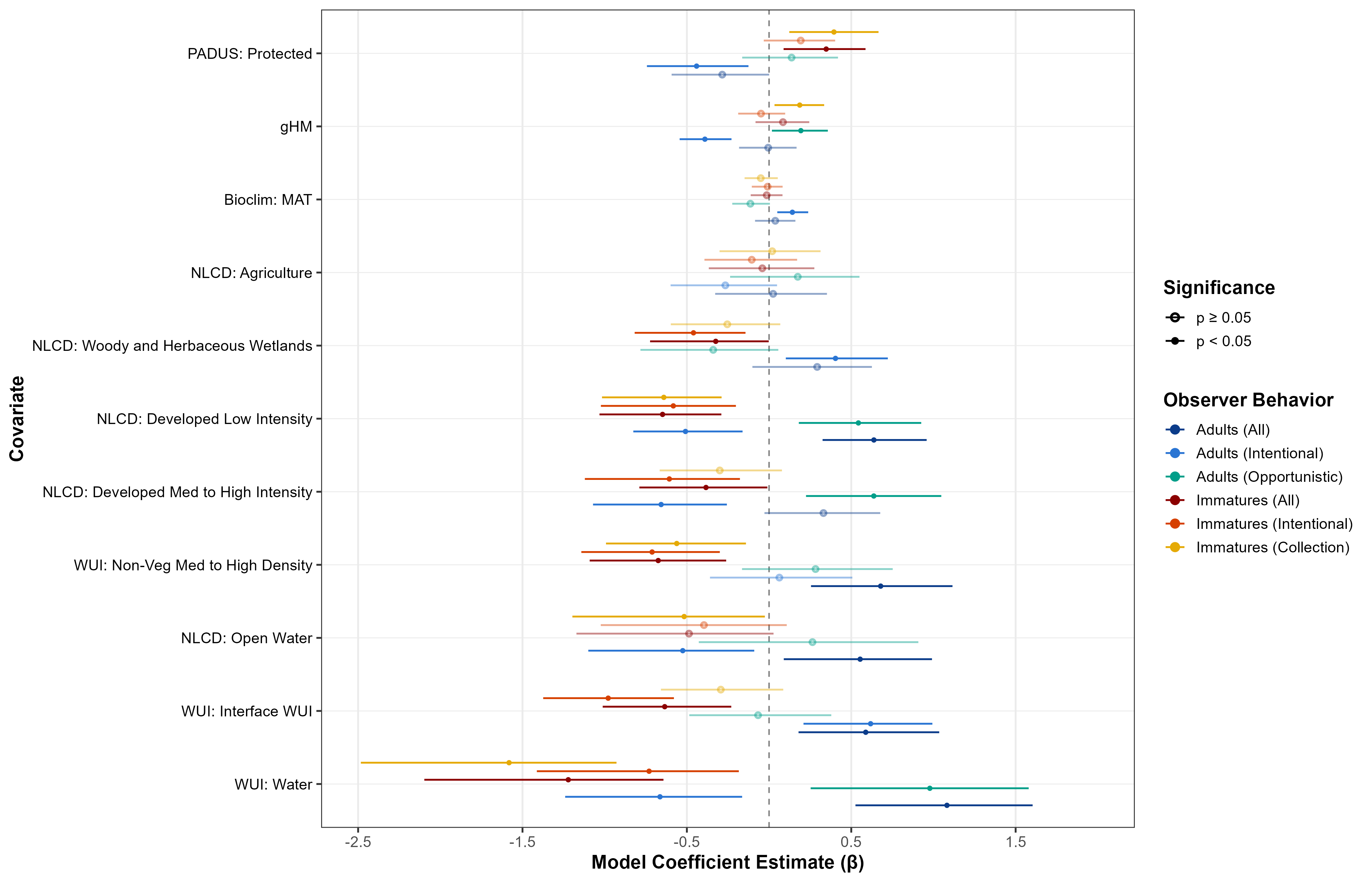
Applying Observer Behavior Derived from Secondary Image Data to Resolve Spatial Biases in Species Distribution Models.
Date:
Torres KM, Pease BS. Poster presented at The Wildlife Society 2026 Annual Conference.
Supplementary material
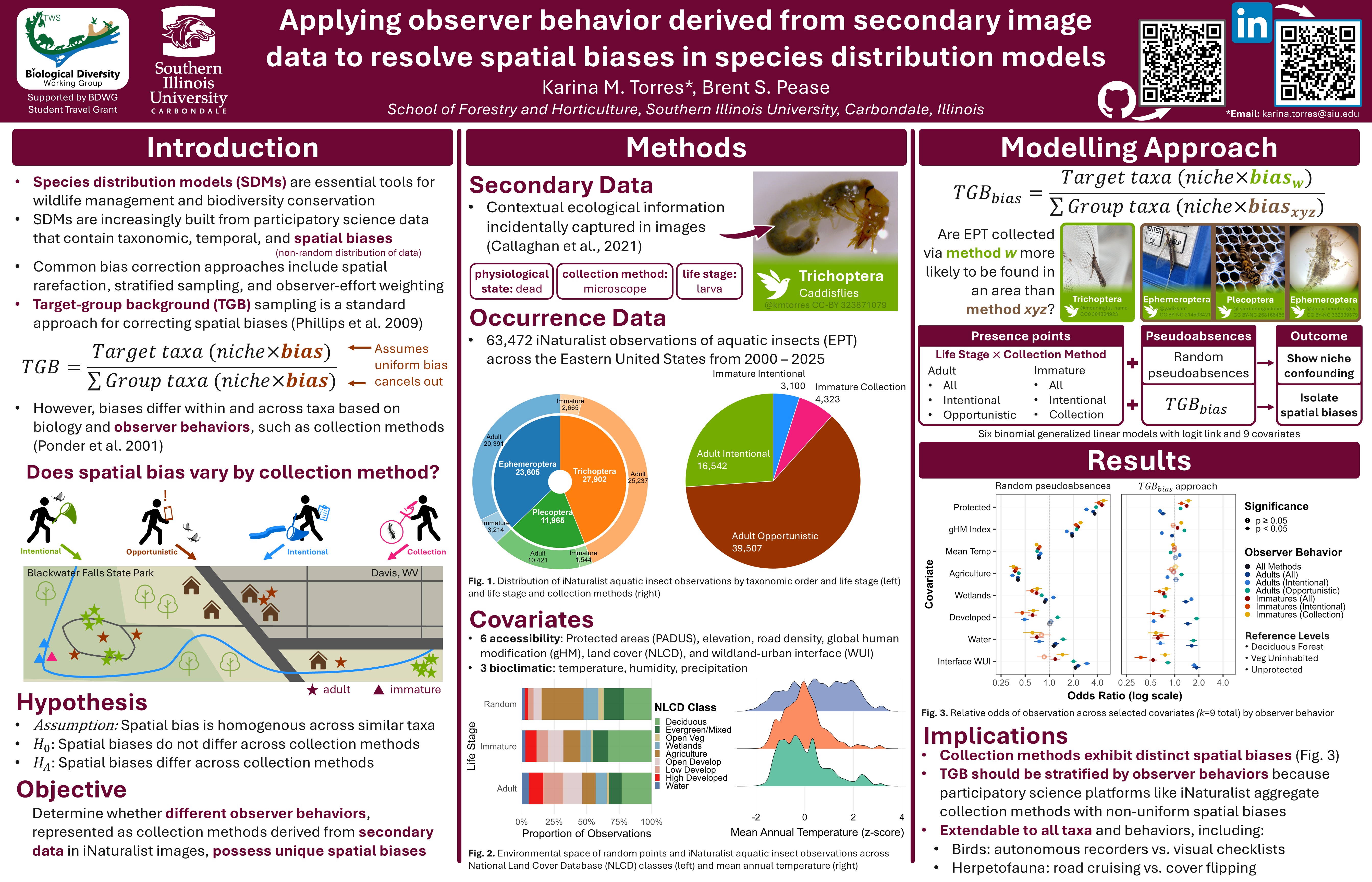
Supp. Fig. 1. Model coefficient estimates across all covariates by observer behavior, using TGB(bias) approach bootstrapped across 1,000 iterations (subsampling target presences at n=508 observations without replacement; background comprising all other non-target observations)
References
- Callaghan, C.T., Poore, A.G.B., Mesaglio, T., Moles, A.T., Nakagawa, S., Roberts, C., Rowley, J.J.L., Vergés, A., Wilshire, J. H., and Cornwell, W.K. (2021), Three Frontiers for the Future of Biodiversity Research Using Citizen Science Data. BioScience, 71(1): 55–63, https://doi.org/10.1093/biosci/biaa131
- Phillips, S.J., Dudík, M., Elith, J., Graham, C.H., Lehmann, A., Leathwick, J. and Ferrier, S. (2009), Sample selection bias and presence-only distribution models: implications for background and pseudo-absence data. Ecological Applications, 19: 181-197. https://doi.org/10.1890/07-2153.1
- Ponder, W.F., Carter, G.A., Flemons, P. and Chapman, R.R. (2001), Evaluation of Museum Collection Data for Use in Biodiversity Assessment. Conservation Biology, 15: 648-657. https://doi.org/10.1046/j.1523-1739.2001.015003648.x